
SDM Voice|Prof. Emi Tamaki
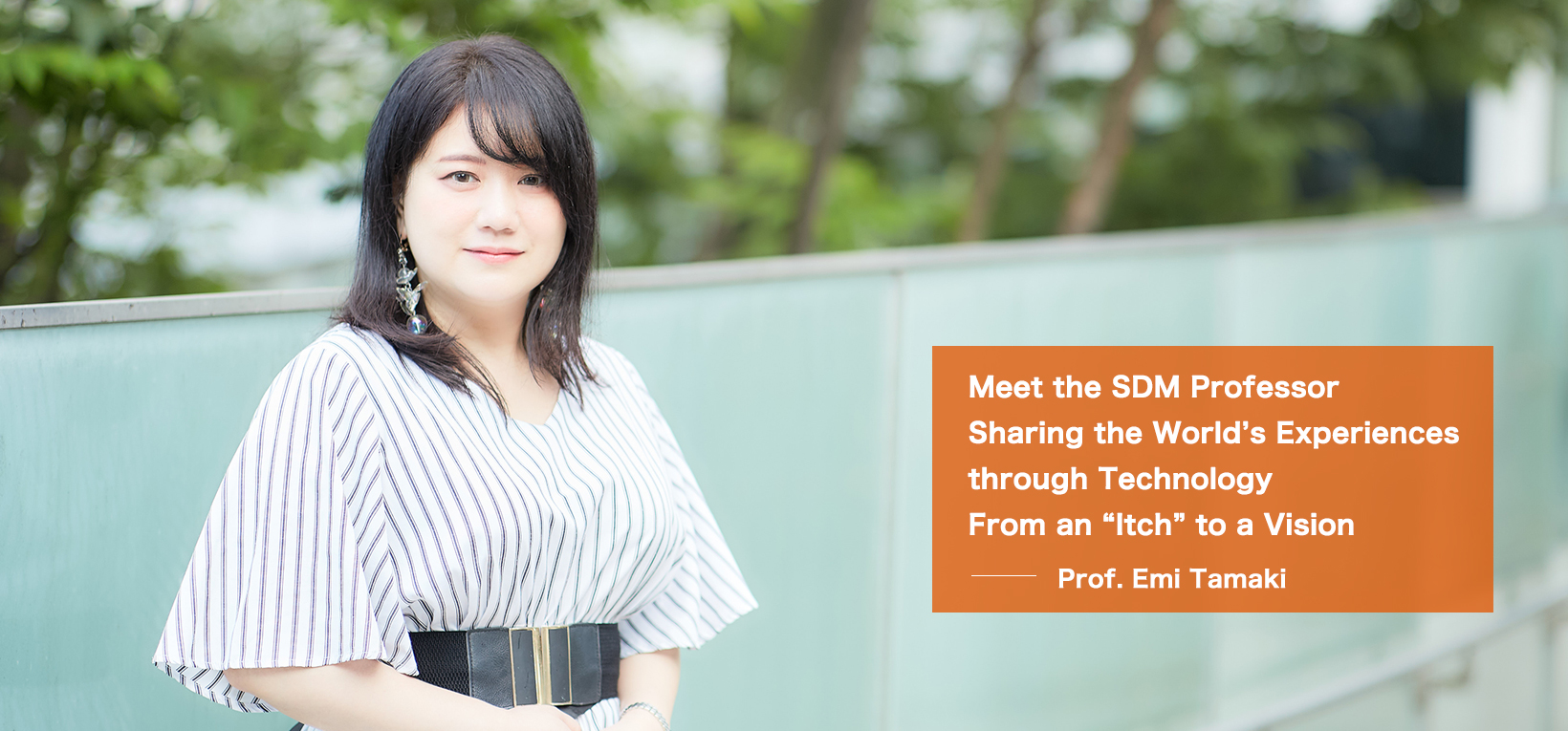
“I want to share in experiences from all around the world as if they were my own.”
Professor Emi Tamaki is the mind behind BodySharing®, a suite of technologies that allows people to share in the sensory experiences of others by exchanging data on proprioception—the body’s sense of its position and movement in space.
We recently sat down with Professor Tamaki to discuss the experience that first set her research in motion and the vision for the future she hopes to shape together at SDM.
Profile
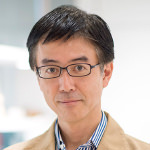
Emi Tamaki
Researcher and entrepreneur Emi Tamaki is the originator of BodySharing®, a family of technologies designed to transmit bodily sensations between humans and computers to enable shared experiences. In 2012, she launched the company H2L, Inc., and has developed a series of BodySharing® interfaces, including PossessedHand, UnlimitedHand, FirstVR, and CapsuleInterface. In 2020, her research on PossessedHand received the Special Recognition Award at the Augmented Humans International Conference for its impact on the field.
Professor Tamaki serves as Sub-Program Director of the Virtual Economy project under Phase 3 of the Cross-ministerial Strategic Innovation Promotion Program (SIP), a Japanese government project between the Cabinet Office, METI, and NEDO. She is also a member of the Green Innovation Project Committee of the METI Industrial Structure Council and an Expert Director at Generative AI Japan.
An Awakening in a Hospital Room
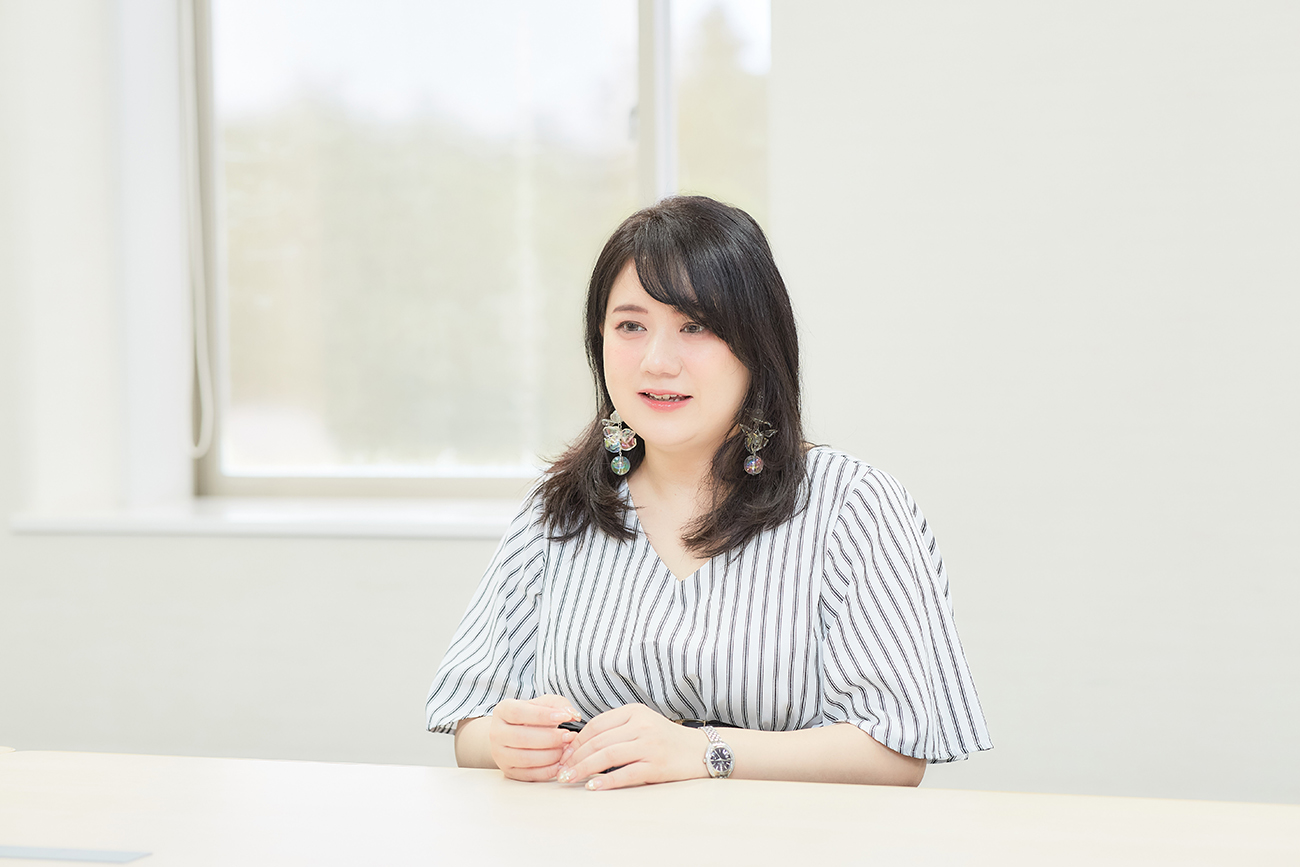
My research interests grew out of an experience I had while hospitalized as a teenager. At one point, I was moved into a six-bed room shared by women ranging in age from their teens to their eighties. We whiled away the days chatting from morning until night. Everyone in the room was drawn to one grandmother in particular. She regaled us with stories of war, love, and a lifetime's worth of other experiences. Conversation with her never seemed to run dry. I envied how she seemed to have led a remarkably full life.
Yet some of the other women in the room were not blessed with the same opportunities to accumulate such experiences of their own. As their lives drew to a close, some looked back with regret and said, "I wish I'd had the chance to experience more..."
To some extent, the amount of the world we are able to experience firsthand is dictated by circumstances beyond our control, such as the type of body we are born with, and the amount of time we are given to spend on this earth. That struck me as profoundly unfair.
I wanted to find a way to help people broaden their range of embodied experiences if they so desired. That desire became the starting point of my research.
If No One Has Done the Research, Do It Yourself
For starters, I asked: How might people go about broadening the range of experiences available to them?
Throughout history, new forms of media have expanded humanity's collective store of experience. Stories were once carried from place to place by itinerant performers known as biwa hōshi. Later came print, photography, radio, television, and eventually social media.
Video calling became available around the time I was in high school, so I decided to conduct a small experiment. I asked a friend to attend a barbecue in my place and hold up a phone so that I could join by video. A barbecue is no fun at all when watched passively through a screen. Although I could see and hear what was happening at the barbecue, the experience was not my own.
Sight and sound are insufficient for making experiences active and embodied, which is to say, for making them yours. The human body is equipped with more than twenty sensory systems. Among them are interoception, the sense that allows us to perceive our internal organs, and proprioception, our sense of bodily movement and the force exerted by our muscles. Our perception of the world is built from layer upon layer of sensory input. Even our recognition that we are holding an apple depends on multiple sensory cues, including its shape, size, weight, and feel in the hand. Even these bodily sensations involve an active, two-way exchange of information.
This, I realized, is the key to the sharing of embodied experience. However, when I searched for a service that might make this possible, I found virtually nothing--not in private enterprise, applied research, or even theoretical research. There was only one conclusion: I would have to do it myself. So, I studied engineering, earned my doctorate, and went about performing the research while laying the groundwork to launch a company of my own.
Those efforts ultimately gave rise to BodySharing®, technologies that allow experiences to be shared from one person to another through the reciprocal exchange of proprioceptive information. First, we developed PossessedHand, a device that uses computer-controlled electrical stimulation to move the wearer's hand. Next, we developed a muscle-deformation sensor to ferry information in the opposite direction, from the human body back to the computer. The sensor uses reflected light to detect subtle changes in the contours of muscles as they contract and relax, providing a noninvasive way to determine which muscles are engaged, and how much force is exerted.
By helping us better visualize how opposing muscle groups coordinate to create movement, the technology has also yielded unexpected insights into how highly trained professionals use their bodies. For example, we found that a select few medal-winning athletes can engage opposing sets of muscles simultaneously, even though one muscle would ordinarily relax as the other contracts. In another experiment, we analyzed the muscle activity of a professional guitarist and "installed" the resulting performance data into my own fingers. My arm immediately seized up and would not move. In short, we learned that trained professionals operate in ways that are simply beyond what regular people like us can manage. (Laughs.)
As our technology becomes more widely available, we hope that it will allow people to vicariously experience the action they are watching on a screen. Someday, you might watch someone lift a heavy rock on a livestream and feel the rock's weight on your own body. Passive viewing would then be turned into an active, embodied experience.
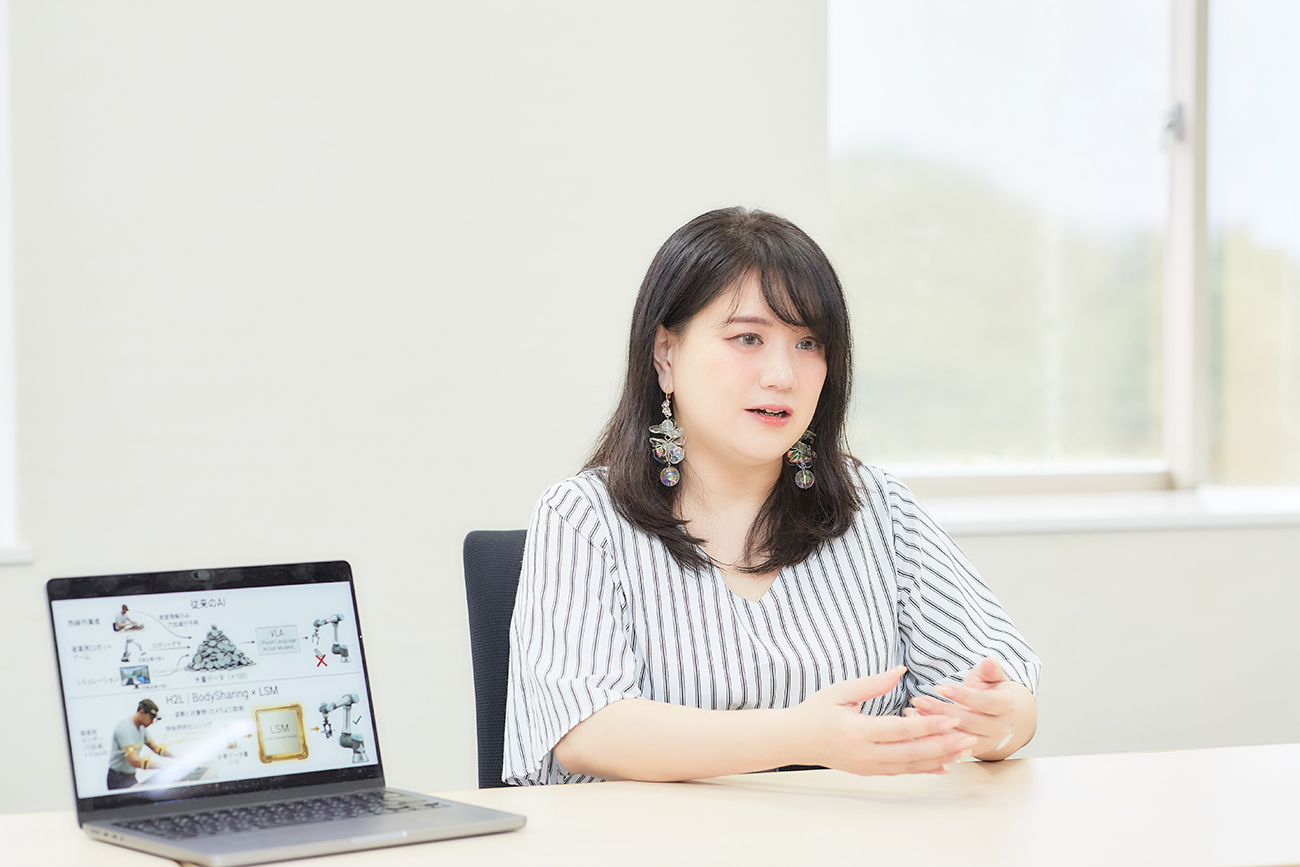
More recently, we have been developing something called CapsuleInterface. This technology detects minute movements in a user's muscles, amplifies those movements to control a robot remotely, and relays the robot's sensory data back to the user. If the user had to reproduce every movement made by the robot at the same intensity, they would tire almost immediately. CapsuleInterface keeps the physical effort required of the user to an absolute minimum, opening the door to experiences beyond the physical limitations of our own bodies.
The proprioceptive data collected through this work is also helping to advance research in physical AI. AI has vast quantities of text to learn from, but sensory data from the human body remains comparatively scarce. By training AI on professionals' motion data, we hope it can learn to generate entirely new forms of movement. We envision a future in which autonomous robots venture out to gather experiences and then share them with us.
We have also begun collaborating with hospitals on a project that helps ward-bound patients by simulating the experience of venturing outdoors. Little by little, I feel that I've come closer to addressing the challenge that first became clear to me from my own hospital bed.
Teaching the Next Generation to Turn an "Itch" into a Vision
At a certain point, I came to realize that in order to achieve something with real social impact, you have to work across academic disciplines. That realization was my motivation for joining SDM. At SDM, people do just that and tackle challenges together, carrying projects all the way from fundamental research to real-world application. SDM offers precisely the environment I sought, and its students arrive eager to take on such challenges.
What struck me most when I joined SDM was the extraordinarily diverse backgrounds of the faculty here. Scientists and engineers work alongside philosophers, and discussion flows freely to touch on ideas from all angles outside of conventional disciplinary boxes. There is a real sense of forward progress, as both our ideas and the institution itself continue to evolve in step with the times.
As an educator, I think the first step is to help each student find that itch that drives them. What kind of world do they want to create? And what knowledge, systems design, and management skills will be needed to make that vision a reality? The path through which a research question emerges matters to me every bit as much as the research that follows.
As generative AI and physical AI play an increasingly active role in the world, it will be up to humans to paint a creative vision for the future. And that vision, I believe, is something that comes from that itch within you. The dreams that students bring to SDM are as varied as they are unexpected. One student yearns to experience life as an animal. Another wants to become a tree. These are visions I would never have dreamt up on my own. Thinking through how to put these concepts into practice has been one of the great pleasures of teaching.
Looking ahead, I hope to create an environment in which students can take greater ownership of their education and learn with independence and initiative. Learning isn't limited to the classroom but also takes place out in the world. Once students "learn how to learn," they gain the ability to flourish as both generalists and visionaries, continually refining their visions long after they have graduated and entered society.
That disparity in embodied experience is fundamentally connected to disparities in education and economic opportunity; it is a major social problem. I envision a society in which experiential data from around the world can be collected, giving everyone equal opportunities to broaden their experiential horizons. And I look forward to building this future alongside the diverse community here at SDM.
-
Prof. Chihiro Hosoda
-
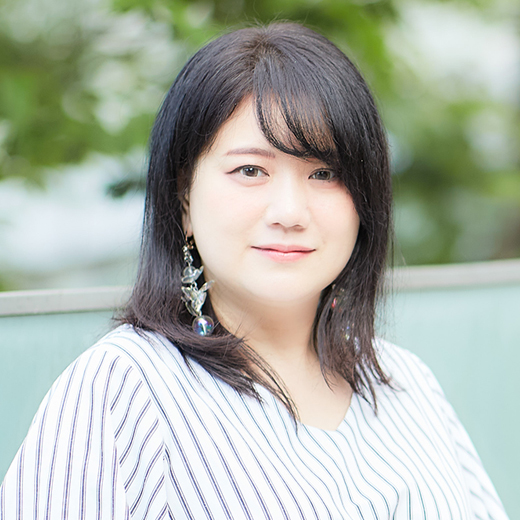
Prof. Emi Tamaki
-
Prof. Yoshiyuki Suimon
-
Prof. Hiroko Inokuma
-
Prof. Takahiro Yakoh
-
Dr. Steven Urueta
-
Dr. Prafull Kasture
-
Associate Prof. Masahiro NIITSUMA
-
Prof. Yoshiki YAMAGATA
-

Naomi Simumba
-
Prof. Naohiko KOHTAKE
-
Prof. Tetsuya Toma
-
Prof. Seiko SHIRASAKA
-
Prof. Hidekazu NISHIMURA
-
Associate Prof. Makoto IOKI